 Scientify
When you hand modeling and computation to an agent, ask whether it can run the work, whether it gets it right, whether it can finish, and whether it has the compute. The two products are compared on seven questions below, each with why it matters, what each side does and the evidence. Screenshots and prices were taken on November 5, 2026.
01
What research it can run
What an executing agent can finish depends on the software, models, databases and lab resources it can call directly.
Mira
- Deep Principle says Mira orchestrates generative AI, first-principles calculation, domain models and databases
- Built-in and custom skills, picked by Mira for each task
- Help-doc cases: deep research, battery-materials simulation, retrosynthesis, paper polishing and figures
Scientify
- More than 130 preinstalled research commands across 11 fields, listed below
- GPU images include GROMACS with GPU support, ColabFold with AlphaFold2 weights and PyTorch
- Searches literature and downloads datasets online; the agent installs missing software in the project
Choose Scientify when you need the agent to run molecular dynamics, quantum chemistry, single-cell or fluid simulations directly.
| Field | Preinstalled software (examples) |
|---|---|
| Molecular simulation | GROMACS, LAMMPS, OpenMM, AmberTools, OpenFF, PyMOL |
| Quantum chemistry | PySCF, Psi4, xtb, DFTB+, CREST |
| Cheminformatics and materials | RDKit, ASE, pymatgen, Open Babel |
| Bioinformatics | samtools, BWA, Bowtie2, HISAT2, Salmon, BLAST, Snakemake, Nextflow, Scanpy; Seurat, DESeq2 and edgeR in R |
| Medical imaging and neuroscience | ANTs, AFNI, MNE, nibabel, PyRadiomics, dcm2niix |
| Earth and environment | CDO, NCO, GMT, MetPy, xarray, GRASS GIS |
| Astronomy and space | Astropy, HEASoft (XSPEC), CIAO, Fermitools, SunPy |
| Engineering simulation | OpenFOAM, ParaView, CalculiX, OpenModelica, EnergyPlus, FreeCAD |
| Statistics and social science | R (tidyverse, lme4, fixest), statsmodels, PyMC, quanteda |
| Numerics and optimization | Octave, Julia, OR-Tools, cvxpy, HiGHS |
| GPU images | GROMACS with GPU support, ColabFold with AlphaFold2 weights, PyTorch, JAX, RAPIDS |
The list comes from the software volume used in production since October 29, 2026; run sci-help on the cloud computer to list everything. GPU images come with the instance when you rent a GPU.
02
Whether results can be trusted
An agent can report success when the work is wrong. Whether to trust a result depends on who defines done and who checks it.
Mira
- Task details show duration, token use, skills used and output files
- Agent squads let you define members' roles, order and hand-offs
Scientify
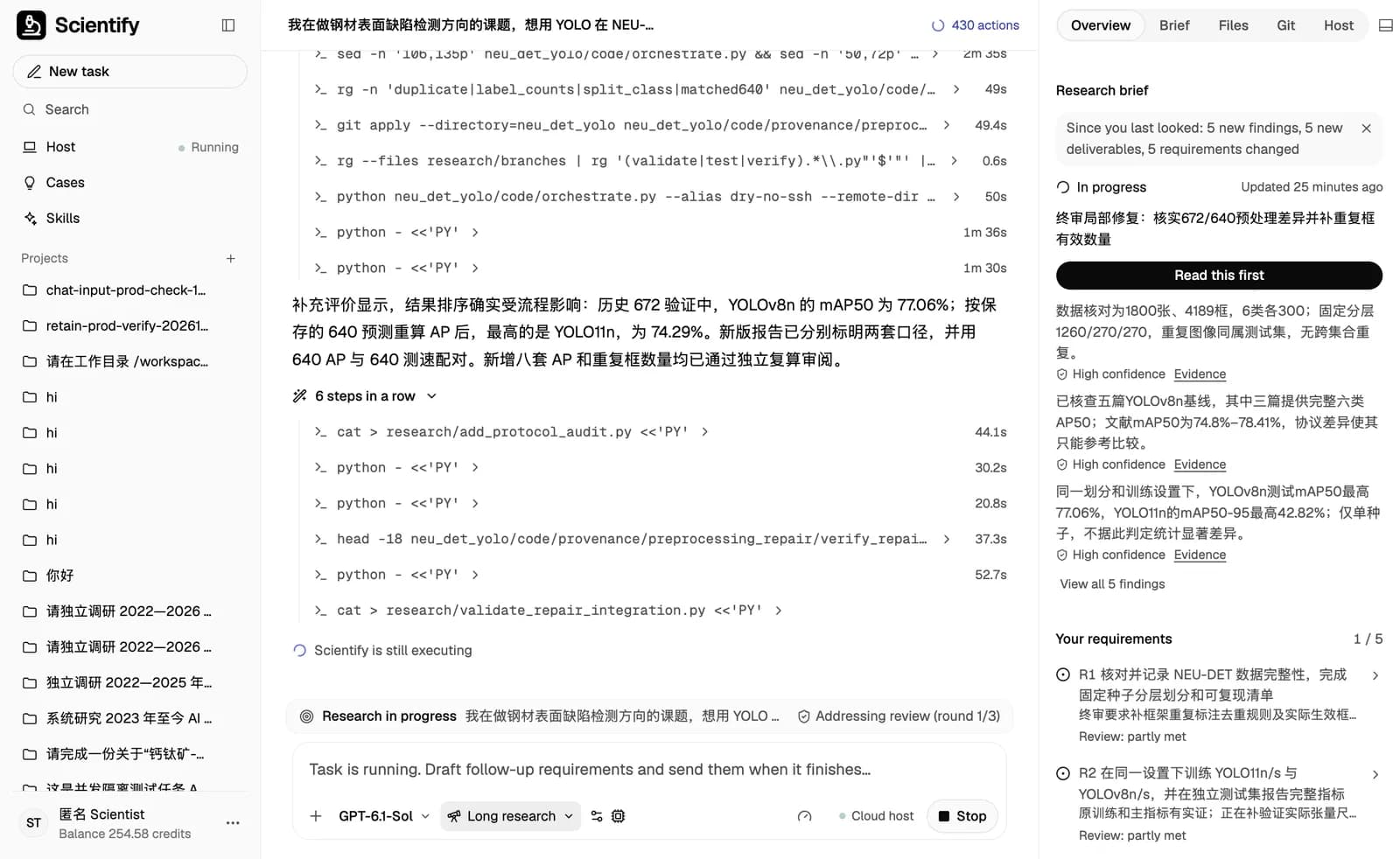
- Before starting, the agent lists research requirements that you confirm or edit as the definition of done
- During the run an independent reviewer checks each requirement; failures are kept as evidence and rerun
- The report states the base model, whether it reproduces a paper or is an original design, parameter sources and rationale, every value and the convergence results, and each item opens its file
- The review and multi-hypothesis methods are open source; the related paper was accepted at ICML 2026
Choose Scientify when you want to agree on acceptance requirements first, have an independent reviewer check each one, and receive a reproducible, reviewable computation report.
03
Whether long tasks can run unattended
Simulations and training often run for hours or days, and nobody can sit at the computer the whole time.
Mira
- A web app; tasks run inside projects and can be stopped at any time
- Scheduled tasks, and tasks sent or results received in DingTalk, Feishu, WeCom and WeChat
Scientify
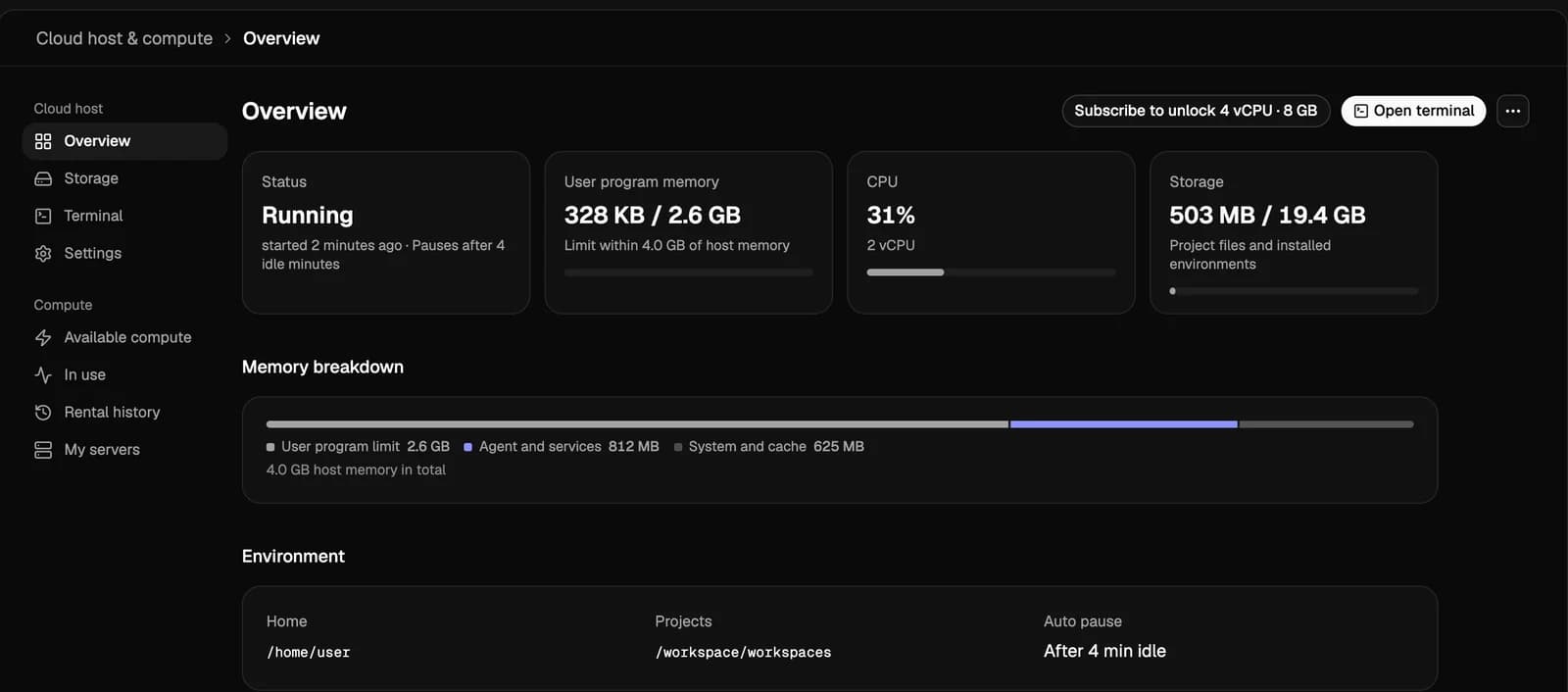
- Each user gets an isolated cloud computer that keeps running after you close your laptop, with no maximum duration
- Pauses after 4 idle minutes, keeping installed environments, data and intermediate results
- Phones and other devices can open the same project to check progress
Choose Scientify when multi-day tasks must keep running and installed environments and intermediate results must persist.
04
How much compute it can use
VRAM decides how large a system or model fits, and the size of the GPU and CPU decides how long you wait.
Mira
- Scientific computing uses the platform's shared pool of CPU/GPU resources
- Mira says it is free for a limited time in the current version
Scientify
- Up to 96 GB VRAM on a single GPU (RTX PRO 6000), plus H800 with 80 GB
- Up to 8 A10G GPUs in one instance; CPU-only up to 224 cores and 3 TB memory
- The agent rents a dedicated instance per task and releases it when done
- Measured: lysozyme molecular dynamics ran at 14.1 ns/day on 2 CPU threads and 367.4 ns/day on one rented T4
Choose Scientify when you need dedicated large-VRAM GPUs, multiple GPUs or hundreds of CPU cores to finish big computations fast.
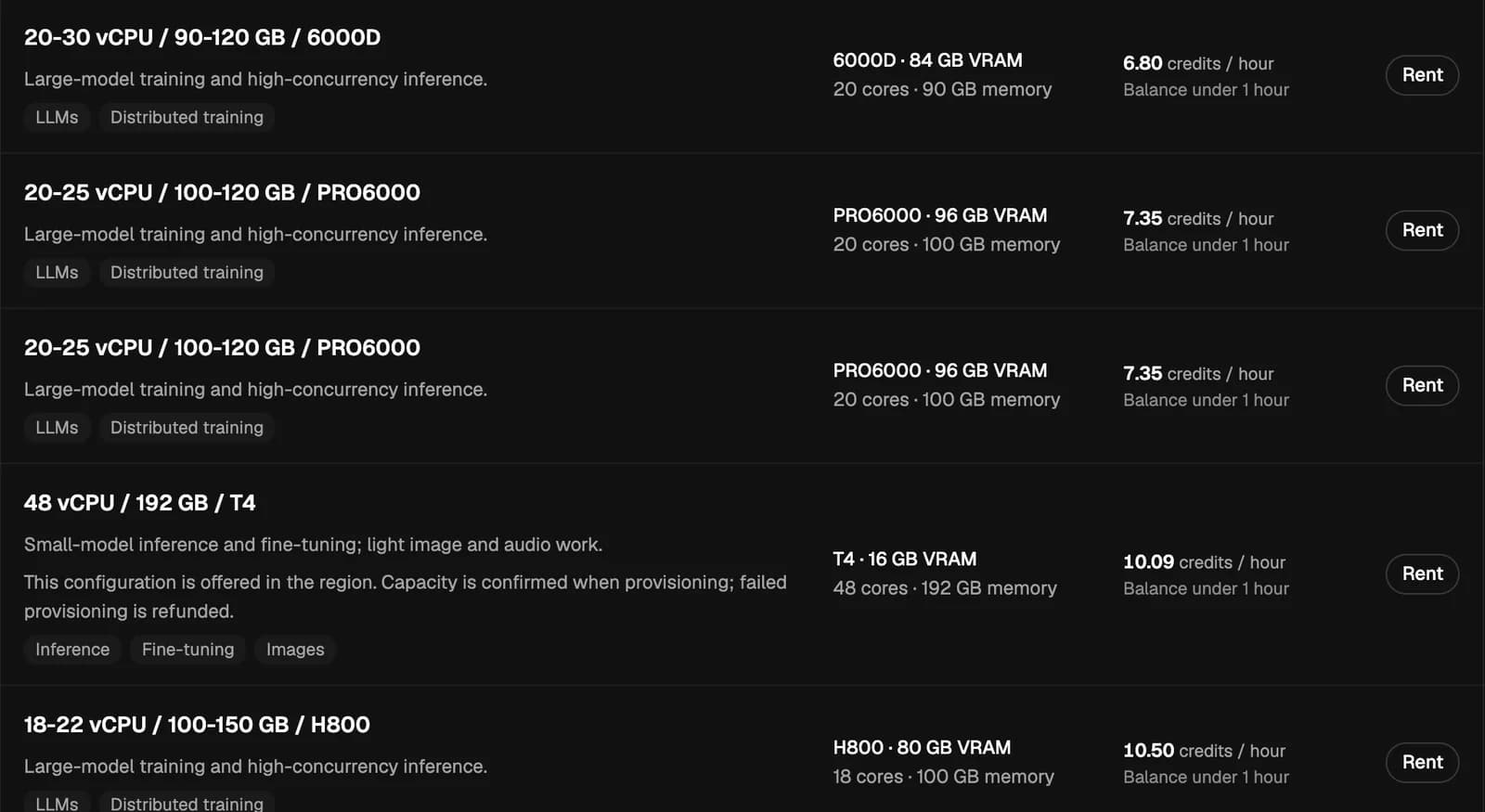
| Spec | VRAM | CPU and memory | Per hour |
|---|---|---|---|
| RTX PRO 6000 | 96 GB | 20 cores · 100 GB | about $2.13 |
| H800 | 80 GB | 18 cores · 100 GB | about $3.05 |
| 4 × A10G | 4 × 24 GB | 48 cores · 192 GB | about $4.24 |
| 8 × A10G | 8 × 24 GB | 192 cores · 768 GB | about $12.15 |
| CPU compute | — | 192 cores · 384 GB | about $4.52 |
| CPU compute | — | 224 cores · 3 TB | about $17.55 |
| T4 (entry) | 16 GB | 4 cores · 16 GB | about $0.40 |
In-product quotes on November 5, 2026, from a catalog of 77 GPU and CPU specs, at the Research plan's paid rate. Prices and stock for some specs change with supply, and a live quote is confirmed before renting; minimum charge is 1 hour and early release is settled by actual time. The two molecular dynamics runs used different solvation boxes and GROMACS versions (27,242 and 23,873 atoms).
05
Base models and pricing
An agent's ability comes mainly from its base model; cost depends on what you pay each month and what share of the official API price you pay for models.
Mira
- 8 base models to choose from; DeepSeek V4.1 Flash is the default
- The in-house Hydrogen-1.0 is post-trained from GLM-5.3 with open weights; Deep Principle says its scientific reasoning is on par with GPT-6-Astra
- Priced in CNY and paid with Alipay
Scientify
- Built on Codex with OpenAI's frontier model GPT-6.1-Sol, no third-party relay
- GPUs draw from the same usage as models, billed by actual time
- Measured: a long-research run over 6 papers with independent review cost $1.27 at official prices, about $0.37 actually paid on the Research plan
Choose Scientify when you want OpenAI's frontier model GPT-6.1-Sol billed at about 30% of the official API price.
| Item | Mira | Scientify |
|---|---|---|
| Base models | Hydrogen-1.0, GLM 5.3 and 5.3 Flash, Kimi K2.6 / K3 / K3.1 Pro, DeepSeek V4.1 Flash and V4 Pro | GPT-6.1-Sol (OpenAI) |
| Monthly price | Pro CNY 49 (CNY 29.9 the first month, CNY 29.4 billed annually), Max CNY 99, ULTRA CNY 249 | Starter $19 (about CNY 133), Research $29 (about CNY 203), Pro $99 (about CNY 693) |
| Free use | Free plan CNY 0 | $5 of usage for new accounts |
| Model price vs official API | Not disclosed | About 30% |
CNY amounts are what WeChat Pay settles at CNY 7 per dollar. Scientify plans include $60, $100 and $350 of official API usage per month, so models cost about 30% of the official price; GPT-6.1-Sol's official price per million tokens is $2 input, $0.1 cached input and $10 output.
06
Whether you can add missing tools
Many projects depend on licensed commercial software on lab servers, or on tools outside any list.
Mira
- Upload .skill or .zip packages or import custom skills from GitHub; the limit depends on the plan
- /skill-finder searches public skill collections
- Agent squads and the AI persona can be customized
Scientify
- Connect lab servers over SSH and call licensed commercial software such as VASP or Gaussian; the agent never sees the key
- Install software and system dependencies that persist
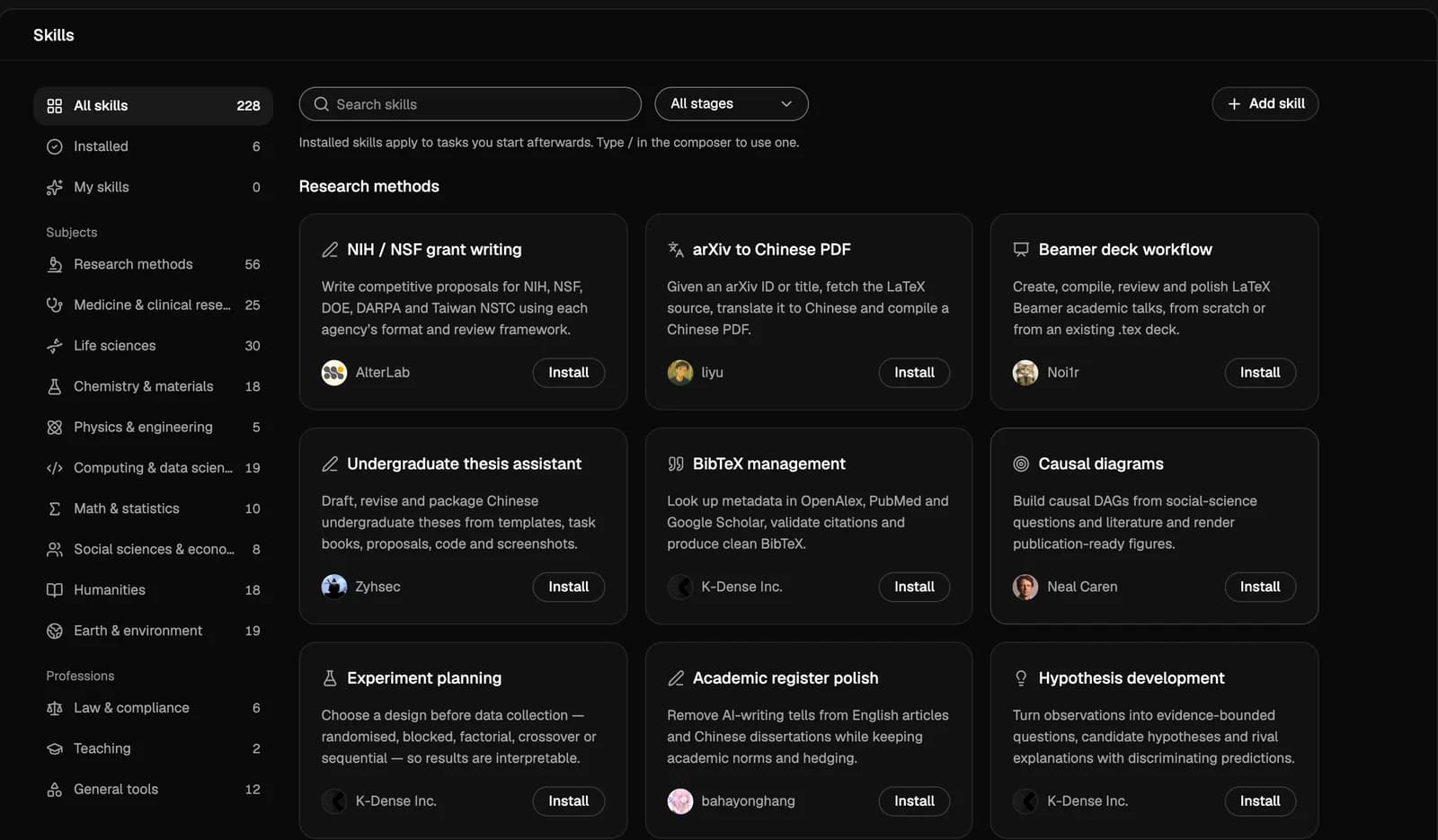
- 228 skills in the skill market, plus skills from GitHub, zip packages or built by the agent
Both support SKILL.md-style skills. Choose Scientify when you need licensed commercial software on lab servers, or software outside the list.
07
Where the data lives
Where unpublished data and code live, and whether they are used for training, decides whether you can hand them to an agent.
Mira
- Task conclusions go into the project knowledge base, which can generate a wiki; the Workshop produces slides, reports and posters
- Data for the mainland China service is stored there and not used for training without explicit authorization
Scientify
- Conversations and project files are stored only on the isolated cloud computer, not on Scientify's servers
- Data is not used for model training; the cloud computer provider is SOC 2 Type II certified
Both commit to not training on user data. Choose Scientify when research data must stay on your own isolated cloud computer, not the platform's servers.
What is Mira?
Mira is an AI scientist platform from Deep Principle. It runs in the browser, organizes knowledge bases, tasks, skills and agent squads by project, and provides a separate CPU/GPU quota for scientific computing.
Are Mira and SciClaw the same product?
Yes. SciClaw was renamed Mira after its beta; the help docs are still titled SciClaw user manual, and sciclaw.cn opens Mira.
Is Mira free?
The free plan costs CNY 0. Paid plans are Pro at CNY 49 a month (CNY 29.9 the first month, CNY 29.4 a month billed annually), Max at CNY 99 and ULTRA at CNY 249, paid with Alipay. Scientific computing and storage are free for a limited time.
Which models does Mira support?
On November 5, 2026 Mira offered 8 base models: in-house Hydrogen-1.0 (post-trained from GLM-5.3), GLM 5.3 and GLM 5.3 Flash, Kimi K2.6, K3 and K3.1 Pro, and DeepSeek V4.1 Flash and V4 Pro. DeepSeek V4.1 Flash is the default.
How are Scientify GPUs priced?
Each spec is billed per hour from the same usage as models. At the Research plan's paid rate, a T4 costs about $0.40 an hour, an RTX PRO 6000 about $2.13 and an H800 about $3.05. The minimum charge is 1 hour; early release is settled by actual time.
When should I choose Scientify?
Choose Scientify when you want to hand over modeling and computation across fields and need it done right and reviewable: computation runs directly, with dedicated large GPUs or hundreds of CPU cores, environments that persist, and licensed software on lab servers.
Method
- Mira information comes from its website, help docs, privacy policy, technical report and the Hydrogen-1.0 announcement; the model list comes from the in-product base model menu on November 5, 2026. No head-to-head test was run.
- Mira here means Deep Principle's product. It is unrelated to MIRA, the open-source framework from an East China Normal University team.
- Scientify screenshots and prices were taken on November 5, 2026. GPU prices change with supply; the live quote at rental time applies.